Pages

Tuesday, 26 February 2019

Blue Fairy on a Pink Donut Fantasy Acrylic Painting Tutorial

 Blue Fairy on a Pink Donut Fantasy Acrylic Painting Tutorial


Glamour Shots


Hey there everyone, Kristina here with another blog post on  acrylic painting.  I decided a fantasy painting would be perfect for this month's tutorial.  I really hope you enjoy painting this as much as I did.

If you are in Hervey Bay, make sure you make time to visit Art and Soul Studio, shop 2/168 Boatharbour Drive, Pialba. 
You can even shop online https://artandsoulstudio.com.au/.

Acrylic paints used in this tutorial:

These colours and more are available at the Art and Soul Studio Hervey Bay.  I mainly use Golden paints and Liquitex heavy body.  Jo Sonja has a gorgeous rich gold that I use.

Mars Black
Rich Gold 
Quinacridone Red
Brilliant Blue
Titanium White
Lavender
Primary Yellow
Primary Blue
Permanent Green Light
Dioxaxine Purple
Brilliant Magenta
Transparent Red Oxide
Burnt Sienna
Flesh Tint
Alizarine Crimson
Yellow Ochre 
Burnt Umber

Paint Brushes Used:

Large Flat Brush
16/0 detailer brush
Size 4 Round brush
Dagger Striper

I used a 16 x 20 inch canvas board. 
Gold Glitter for the fairy wings
Golden Super Gloss Varnish

Let's begin the fun!

First step is usually to paint the back ground, this makes things a lot easier and saves you a lot of time.  So if you know what colour you want the background to be then do it now.  I wasn't sure what colour I wanted until the very end.  I chose Mars Black.  So paint the whole canvas Mars Black.

Wait for the paint to dry and sketch the shape of the donut onto the canvas.  Then paint the whole donut Yellow Ochre.  

Mix some quinadicridone red and titanium white to make the pink colour of the icing. This colour pink is perfect.


Paint over the sections marked for the icing with the pink paint. Use Mars Black to paint in the hole of the donut.
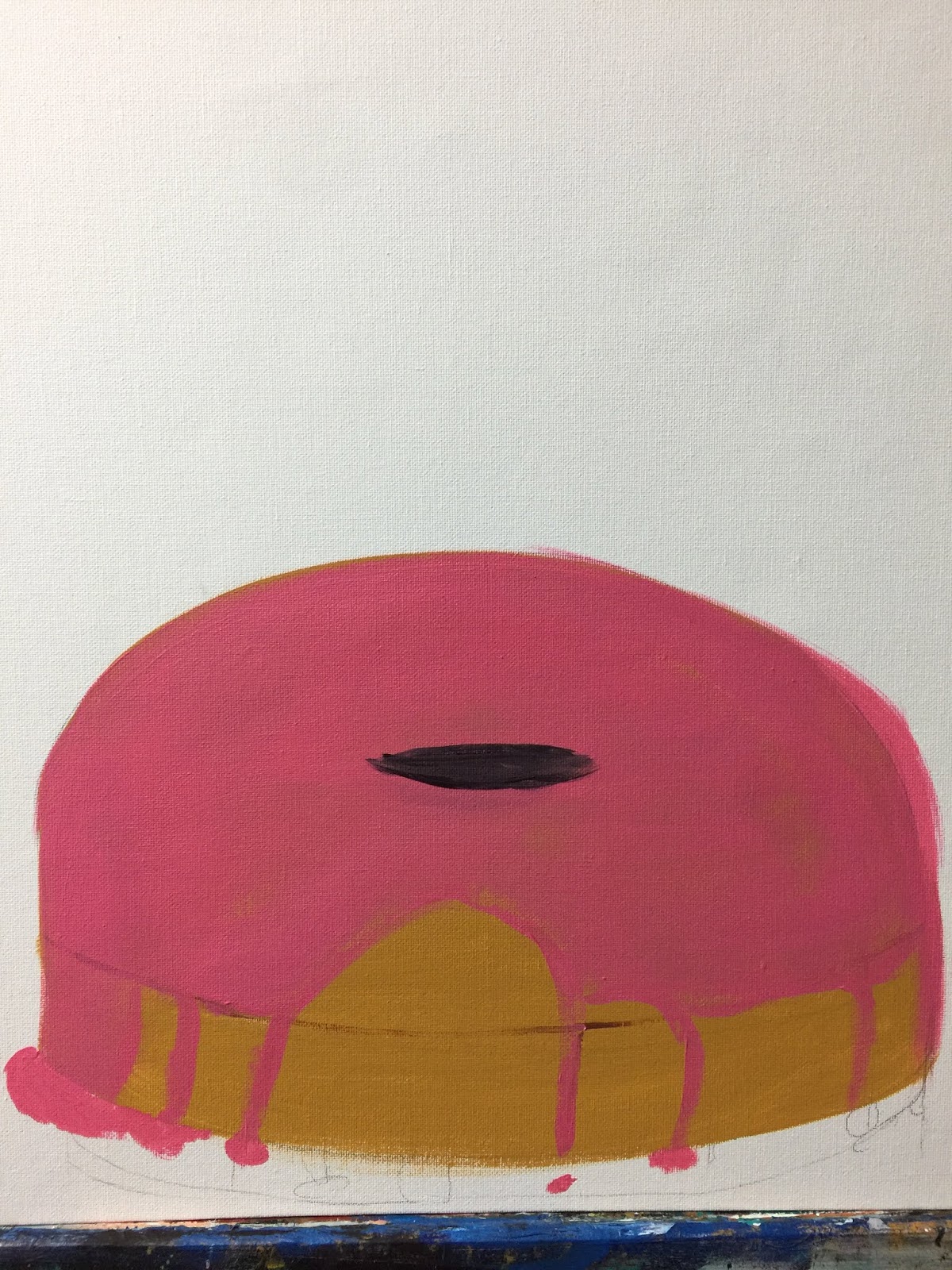
Don't worry, a few more layers and this donut will look scrumptious.

To make the texture of the dough, using a round brush just dab dots all over the yellow ochre part of the donut, using a combination of burnt sienna, yellow ochre and burnt umber mixed, burnt umber, yellow ochre and white mixed.  Cover the whole area in lots of dots, keeping the bottom of the donut darker, and the parts directly under the icing darker as well.

Using burnt umber and the round brush, draw a curved line approximately half way down the donut, to form the crease.  Add some titanium white to the burnt umber and draw a lighter line on the top and bottom of the burnt umber line to indicate highlights.


Painting the icing:

Adding shadows and highlights to the icing makes it look more realisitic, so let's get to it.

Using a 3:1 ratio of Quin red and Titanium White, make a darker pink to begin the shadows along the back edge of the donut.  Use the flat brush to curve your stroke up from the donut hole, in a curved motion forming a backwards "C".


Now for the darker highlights, just use Quin red, and a small amount of the Green Light (being opposite on the colour wheel the green will darken the red perfectly).  


Shade the donut as shown above, then using the round brush and the same colour paint a line at the bottom edge of the pink icing and the edges of the icing drips.

For the highlights use the quin red and titanium white mixture, adding more white to make it nice and light.
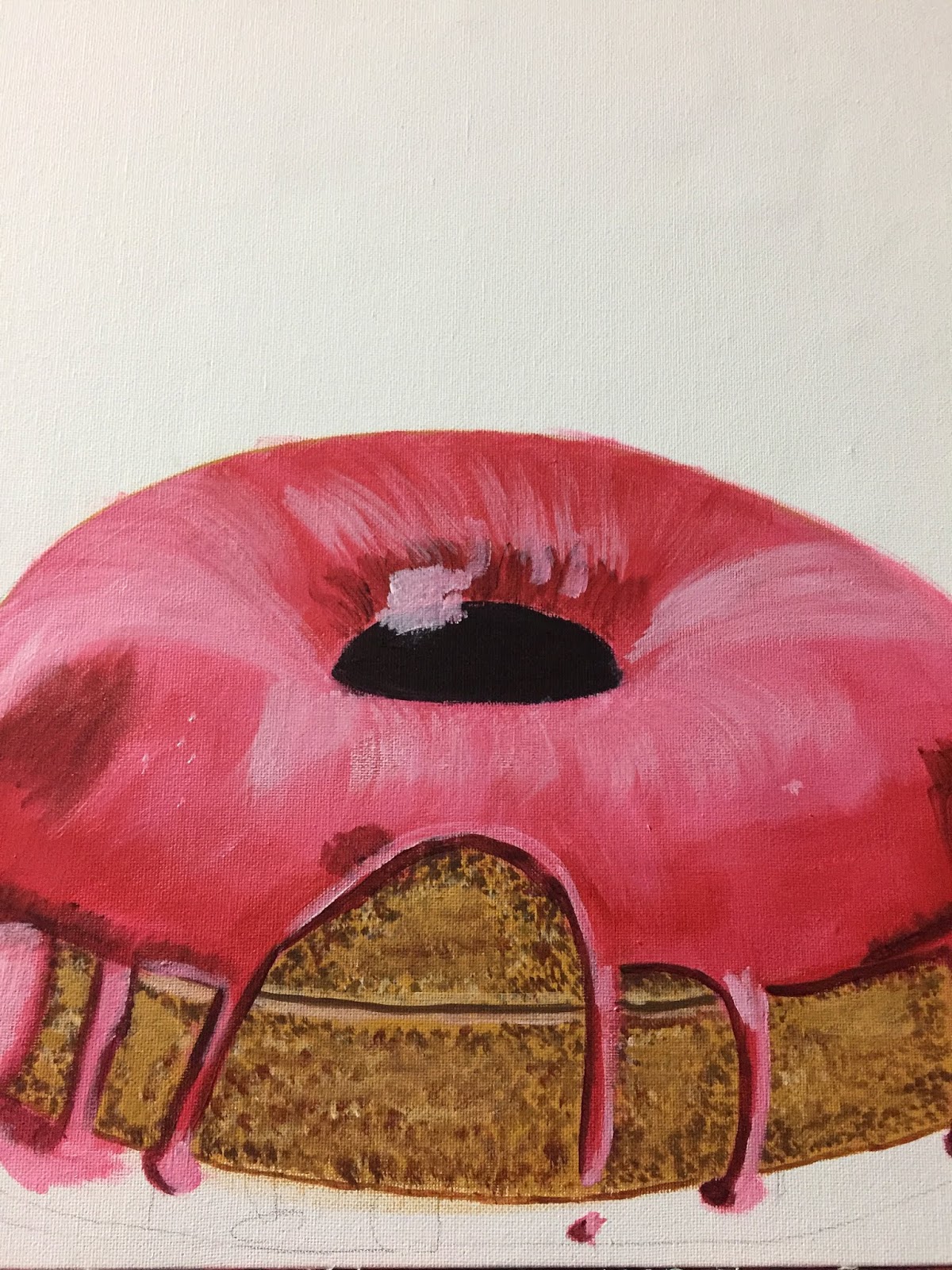

When painting the top of the donut, make sure you do a curved motion to make the top of the donut appear curved.  Using the light mixture of the pink and white, add the highlights as shown above.  Making sure each stroke is curved in the way you want the donut to look.

Add highlights to the icing drips as well.


Painting the sprinkles:

This is quite easy, just get the colours for the sprinkles....Primary yellow, titanium white, lavender, green light and quin red.  Paint a little line where ever you want the sprinkles, in all different directions.  To ensure nice coverage of the yellow, paint the lines white first, then wait until it is dry and paint the yellow over the top.  

Add darker colours to the bottom of each sprinkle for the shadow, and a touch of white on the top for a highlight.  This adds depth to the sprinkles.


 The donut should be looking like this, nice and edible.

Painting the fairy:


This is the traceable for the fairy, this image was downloaded off Pixabay and is free to use.  Just don't draw in the mushroom as she is sitting on the donut.  Trace the fairy into position on the top of the donut.  I used pencil so you can see it.  It is best to use chalk, watercolour pencil or transfer paper.


Using flesh tint, do a first layer on all of her skin parts, head, chest, arms and legs.


 Use the brilliant blue to paint in the fairy clothes.


Mix transparent red oxide and yellow ochre 50/50 mix.  Add a touch of Alizarin Crimson and then mix titanium white into this mixture.  You should have a darker skin tone to paint in the creases and the shadows.  Use this darker mixture to paint in the lines on her chest, under her neck, her collar bone and the outside of her legs and arms.  Where all the creases will be.


While the darker colour is still wet, use the flesh tone to blend the darker tone into the lighter tone.


The face on this fairy is very simple.  Using the darker flesh tone, paint in the outlines of the mouth, eyes and the sides of the nose.  See how hinting at the lines on the face actually makes a face appear.  It is a very simple and easy face to paint.  Paint in the hair using Primary Blue, following the direction of the hair.  High light the inner part of her breast with a lighter flesh tone.


To make the fairy a little naughty, by having bites taken out of the donut is fun and quirky. Using yellow Ochre and the round brush dab along where you want the missing piece.

Add some burnt umber and burnt sienna dabs to this bite too. 


Dab mars black around the edge of the bite, and then highlight this with titanium white.  Make sure the top half of the donut is darker, to hint at the shadow.
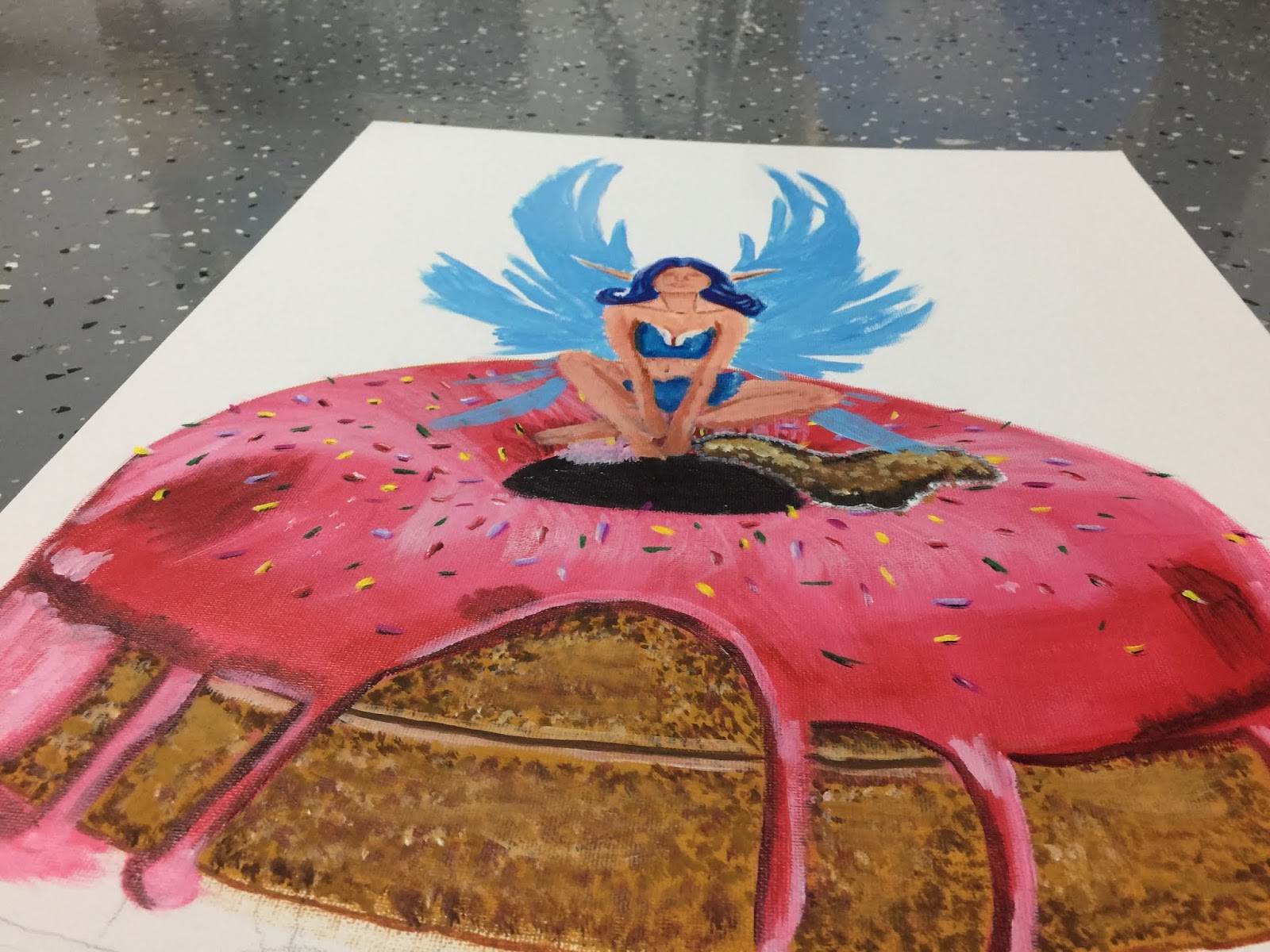
Almost at the end, painting her wings.  Using brilliant blue paint along the wings that you have traced on.  Do a couple of coats of blue, adding some darker tints to the parts closest to her body.

Then add rich gold to the top parts of the wings, and while the gold is wet, sprinkle gold glitter on the wet paint.  Do this for both wings.


Go over any part you think needs extra highlights, like her hair or parts of her face.  Add more glitter to the back ground, do whatever takes your fancy.  This is your painting, make it yours and enjoy the process of creating. 


Until next time.........


Sunday, 17 February 2019

 Making a Venetian Mask using Helmar Craft PVA glue.

IMG_8424 2

IMG_8426 2


G'day crafters, Kristina here with my latest project, a stunningly gorgeous hand made Venetian mask.  I am absolutely in love with this project.  It turned out better than I had hoped for.  I was given the challenge of using one glue, as this blog post is a product spotlight.  So I decided to use the Helmar Craft and Hobby PVA glue.  It worked amazingly, so, onto the instructions.

Helmar Products used:
Helmar Craft and Hobby PVA glue

Other items required:

Cheap mask from cheap shop (mine cost $2.50)
Crackling Paste or medium
Rich Gold acrylic paint
Unbleached titanium acrylic paint
Paint brush
Black acrylic paint
Newspaper
Gold feathers (or white which you can paint gold)
Gold tipped feathers (or white which you can paint the tip gold and put glitter on)
Embellishments to decorate the face (I raided my stash)
Gloss Varnish
Gold leaf
Gold glitter

Painting the feathers if you have white ones.
If you could not find gold feathers, or gold tipped feathers, then this is how you make your white ones gold.  You will need a fan brush and the rich gold paint.  Place the feather onto paper so you don't get paint everywhere.  Start from the bottom of the feather with the fan brush, painting in an upward motion so as not to disturb the feather too much.  Cover the whole feather in gold paint and leave to dry.
For the gold tipped feathers, using your fan brush and the gold paint, start about an inch from the top of the feather and paint up.  When it is covered in paint, sprinkle some gold glitter on it and let it dry.

Quick video of painting a gold tip feather is here:  

IMG_8398

Instructions

To begin with, you need to make the cheap mask a little more sturdy, so begin with ripping up the newspaper and covering small areas of the mask in the PVA glue, and begin to paper mache the whole mask.  It should begin looking like the picture below.  Just keep going until the whole mask is covered in newspaper and glue.  You will need to do two layers of paper mache, so wait until the first layer is dry before you begin the second layer.

IMG_8379 IMG_8380

You should have something like this when you are done with the newspaper.  Make sure you let it completely dry and harden before going on to the next step.  Once dry, give the mask a quick sandpaper just to remove any sharp or bumpy bits of newspaper.

IMG_8381

Painting the Venetian mask

If you want the crackle effect then you will need two colours of acrylic paint.  The first colour you paint on will be the colour seen between the cracks of the top colour.  I wanted gold cracks so I used Jo Sonja Rich Gold acrylic paint for the first layer.  You will need to do at least two layers of the gold paint, to ensure perfect coverage of the mask.  Your mask should look a little like this.

IMG_8383
Ensure that the gold paint is completely dry, let it dry for an hour or so before even thinking of using the crackle medium.  Each crackle medium may have different instructions, so make sure you follow your instructions on the bottle.  You cover the whole mask in the crackle medium, very thick, and try not to brush it in too much, just leave it to sit on top of the paint.  My instructions said to wait at least 4 hours before putting on the next layer of paint.  I have included a quick video of the crackle medium beginning to work while I am painting the top coat on the mask.


Once the medium is dry, cover the mask in unbleached titanium acrylic paint.  You should be able to see the cracks appearing as you paint the mask.  This was super fun to watch happen.
IMG_8387

See all those lovely golden cracks appearing in the paint?  Super exciting right!!  This is what it should look like now, and the longer it is left the more cracks that will appear.

IMG_8389

IMG_8388
Just leave it to crack away, and dry for about an hour, just to be safe.

Painting the lips and the nostrils

Use the rich gold acrylic paint to paint over the lips on the mask, do two layers.  Use the black acrylic paint to put in some nostrils.

IMG_8401

Gluing on the gold leaf

You will need your gold leaf and your Helmar craft and hobby glue.  In chalk, lightly draw on the mask where you want your gold leaf mask to go.  Make it kind of a butterfly shape.  Then you put a small amount of glue in the area marked off, wait about two minutes for it to begin drying and place a small amount of gold leaf onto the glue, pressing down gently on the gold leaf to flatten it. 
Just a word of advice, if you have never touched gold leaf before, it likes to cling to your hands, rips apart and flies away in the slightest breeze, and can disintegrate on your fingertips if you rub it too much.  It can be difficult to work with to begin with, but once you understand it, it is definitely worth the fussiness.
Just continue to gently place the gold leaf onto the craft glue until the whole area you marked off as the mask is covered.  It does not need to be neat at this stage.


I found if I put the craft glue in a paint palette and used my fingertip to rub it on the mask it was a lot easier.  See picture below.

IMG_8409

Gluing the gold cord around the gold leaf area.

Before you begin the second layer of gold leaf, it helps to glue the gold cord that you have to outline the gold leaf mask.  This takes away the need for clean edges on the gold leaf, which is rather difficult.  Use your glue to outline the area around the gold leaf, in small areas at a time and glue the gold cord onto the mask.  The gold leaf will still be rough looking but that will be fixed in the next step.  Give the gold cord time to dry before doing the second layer of gold leaf.


IMG_8411
Smooth out the gold leaf using a soft paintbrush and holding it over a bin (it will make a mess).  Just gently brush along the gold leaf to smooth it out, and to remove the unstuck pieces.  Now you do your second layer of gold leaf.  Just place little bits of glue in the spots that require gold leaf, don't place glue all over the mask.  Place the gold leaf on all the little spots, wait until it's dry and smooth it out.  Do this two or three times and your gold leaf will be amazing.
Decorating the mask
I found some gold decorations to place around the eyes, to make them stand out more.  Use glue to go around the eye and stick on whatever decoration you have.
IMG_8413
Use anything you have to decorate the mask how ever you please.  I wanted minimal decorations, with just one little pop of colour, so I found a purple gemstone and a gold embellishment and I placed it between the masks eyes.

IMG_8415

Gluing on the feathers

You should have dry feathers by now if you did the feathers at the beginning.  All you need to do is glue them on to the mask.  Sounds easy right?  Well it is, but you need patience.
Using the craft glue place a little bit on the end of the gold feather, about 2cm from the end of the feather.  Then hold it onto the edge of the mask, at the back.  It is as simple as that, but you need to hold it until it is kind of stuck otherwise it will fall off.  When I was sure the glue wouldn't stick to the paper underneath the mask, I put it down for five minutes so the pressure would push the mask onto the feathers even more.

IMG_8416
IMG_8417
This is the time consuming part, but it is very much worth it.  Just keep going along until the whole top and most of the sides of the mask are covered in gold feathers.  I glued an embellishment along the edge of the feathers for a little more pop, and to help hold them in place.  Let all of the gold feathers dry before beginning the gold tipped feathers. 

IMG_8418
The gold tipped feathers are place underneath two gold feathers, about half way up the gold feathers so they are higher.  Using the craft glu, place a little bit of glue on the underside of two gold feathers and then place the gold tipped feather on the glue.  I placed a paintbrush under the mask while doing this to raise it up so the gold tipped feathers wouldn't stick to the paper.

IMG_8421 IMG_8422
You can place as many layers of feathers as you please.  I really hope you enjoy making this Venetian mask as much as I did.  To get all of this done using only one glue is pretty amazing.  I definitely recommend Helmar craft and hobby PVA glue for this project.  Enjoy making this and I will see you next month.

43951369_710339359330536_8230164289923579904_n